WP leader: Dr. Amine Abadi (NPZ Innovation GmbH)
Email:Co-WP leader: Dr. Steffen Rietz (NPZ Innovation GmbH)
Co-WP leader: Christian Flachenecker (Norddeutsche Pflanzenzucht Hans-Georg Lembke KG, Hohenlieth Holtsee)
Co-WP leader: Prof. Daguang Cai (Christian Albrechts Universität Kiel, Institut für Phytopathologie, Kiel)
Co-WP leader: Prof. Dr. Remco Stam (Christian Albrechts Universität Kiel, Institut für Phytopathologie, Kiel)
Staff:
- Michael Stuhr (NPZ Innovation GmbH)
- Matthias Enders (NPZ Innovation GmbH)
- Andrea Ulrich (Christian Albrechts Universität Kiel, Institut für Phytopathologie, Kiel)
- Hendrik Seide (Christian Albrechts Universität Kiel, Institut für Phytopathologie, Kiel)
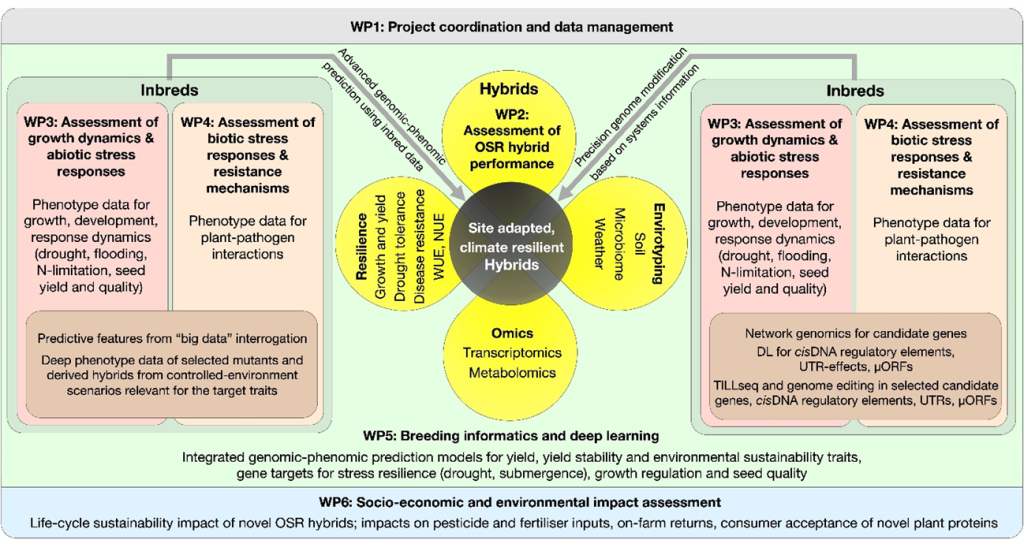
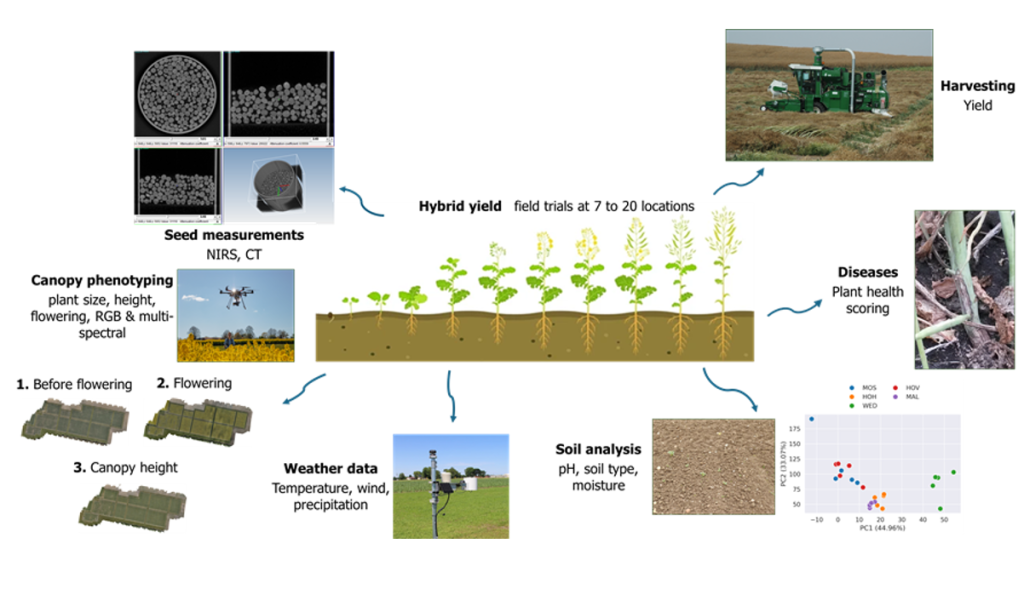
Yield stability and further increases in productivity and quality of winter oilseed rape (WOSR), the most important oilseed rape crop in Central Europe, are challenged by changing weather conditions and efforts to increase sustainability in agriculture. INTEGRA aims to support the generation of high-yielding, climate and site-adapted WOSR hybrids with novel functionalities and adaptation to future agricultural practices with reduced fertiliser (N) and pesticide inputs, simultaneously exhibiting high yield stability and improved product quality. The production of climate-resistant and site-adapted novel varieties requires the consideration of complex genotype-environment (GE) interactions. WP 2 will generate multi-location phenotypic data, recorded over three cropping seasons. Data will be compiled from field trials using pre-commercial breeding material of genetically diverse rapeseed lines and hybrids. Deep field phenotyping will cover a wide range of traits, including those linked to plant development, yield, seed quality, disease resistance and agronomy. In addition, comprehensive environmental data recording weather and soil conditions will be collected to enable genotype- by-environment (GE) modelling in INTEGRA. Furthermore, samples from field trials will be made available to monitor rhizosphere microbiomes and plant-associated microbial pathogens, revealing insights into site-specific biotic interactions. Samples from field-grown plants will also
be made available to facilitate the generation of transcriptome profiles, enabling the investigation of sources of differential hybrid performance and the identification of differences in regulatory networks across environments. Generated data will be integrated into multimodal INTEGRA analyses to reveal key environmental factors that affect plant performance, as well as the respective genetic plant features and modelling approaches.