Project leader: Dr. Henriette Uthe
Co-Project leader: Prof. Thomas Altmann
Phenotyping of growth dynamics and abiotic stress responses under controlled field-like conditions
- Dr. Rongli Shi
- Dr. Rhonda Meyer
- Dr. Dominic Knoch
- Dr. Markus Kuhlmann
Co-Project leader: Prof. Rod Snowdon
Assessing genotype-specific responses to early flooding stress in winter oilseed rape
- Dr. Benjamin Wittkop
- Lars Erik Thomsen
- Jason Wenzig
Detection of informative / predictive features, markers and “suspect genes”
- Dr. Jedrzej Jakub Szymanski
- Dr. Qinqin Long
Targeted mutant generation via gene editing
- Dr. Jochen Kumlehn
- Christina Sievering
Oilseed rape (Brassica napus L.) is the world’s third-largest source of vegetable oil and a key protein meal crop, but its yields are declining due to increasing weather extremes, such as flooding, drought, and heat waves. Breeding efforts for higher productivity and yield stability in winter-oilseed rape therefore require a deeper understanding of the genetic, molecular, and physiological mechanisms underlying plant responses and resilience to these abiotic stresses.
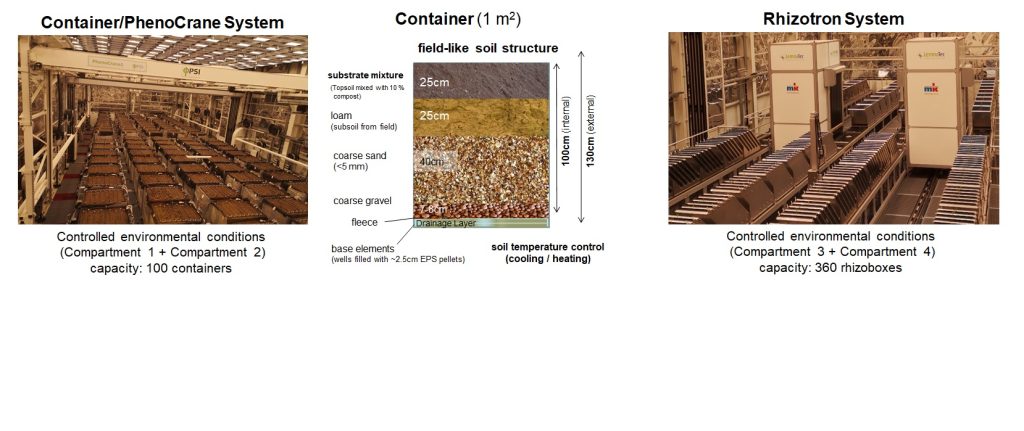
Work package 3 addresses the growth dynamics and abiotic stress responses of Winter oilseed rape (WOSR). In order to investigate the Brassica napus plant performance under selected stress conditions the state-of-art Phenotyping facilities of the participating partners are used: The DroughtSpotter XXL precision phenotyping facility at Justus Liebig University in Giessen (JLU) is used to investigate 40 selected WOSR lines. At the Leibniz Institute of Plant Genetics and Crop Plant Researcht in Gatersleben (IPK) the abiotic stress responses of the rapeseed plants are investigated under fully controlled conditions: The Container/PhenoCrane System of the IPK PhenoSphere is utilized to investigate 12 selected lines under four treatments: control (C), autumn waterlogging (aWL), spring–summer drought (s/sDS), and combined waterlogging & drought (aWL+s/sDS). Root and shoot phenotyping experiments in the Rhizotron system are performed to analyse subsoil plant drought stress responses. Novel candidate genes are identified and modulated via TILLING or NGT.
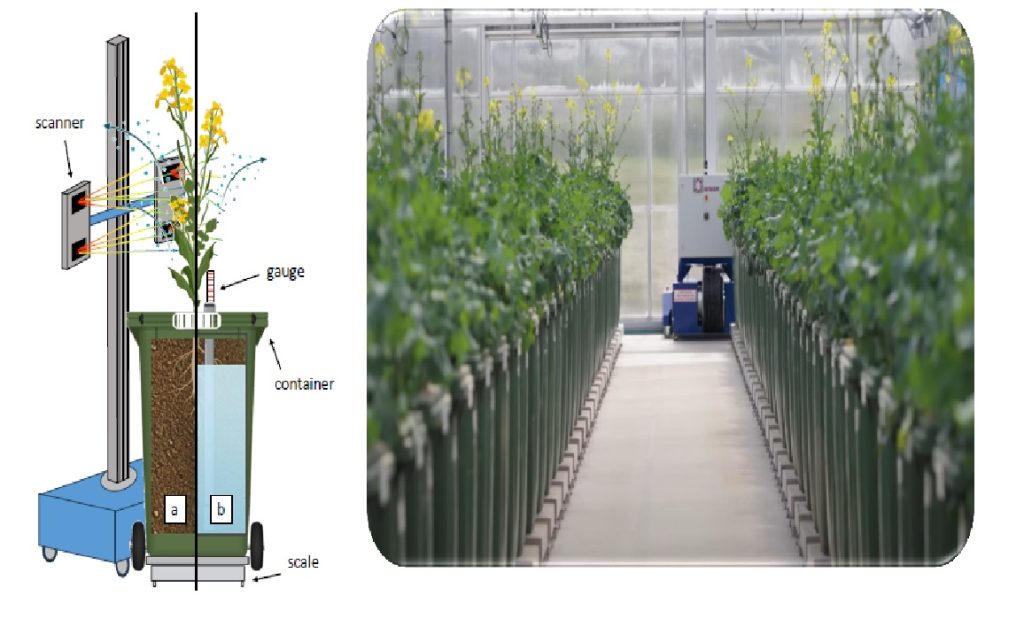
The DroughtSpotter XXL precision phenotyping facility at Justus-Liebig-University Giessen provides an innovative platform for plant research under semi-controlled conditions that closely mimic field environments. The facility’s core infrastructure comprises large 120 L containers filled with natural arable soil, enabling cultivation of crop populations at field densities throughout their complete lifecycle. This container-based approach effectively addresses a critical limitation of traditional greenhouse studies by allowing unrestricted root development, thereby improving the ecological validity of experimental results.
The facility integrates advanced automation systems, including programmable irrigation for precise water level control, which is particularly valuable for studying water-related stress responses. Real-time gravimetric sensors operating at 5-minute intervals continuously monitor water input, soil water status, and plant water use from early developmental stages through to maturity. For comprehensive phenotypic characterization, the facility employs automated multispectral 3D imaging technology that non-destructively captures temporal changes in morphological and spectral traits. This high-throughput phenotyping capability enables detailed longitudinal assessment of plant responses to environmental conditions.
The system has been validated through extensive experiments demonstrating high accuracy in predicting field yields based on container-grown plants, confirming its suitability for stress physiology studies and pre-breeding evaluations. By successfully bridging the gap between highly controlled laboratory conditions and real-world agricultural settings, the DroughtSpotter XXL facility enhances the translational value of plant research, enabling breeders to screen genetic materials for complex abiotic stress response traits with confidence in their field relevance.